ChatGPT Ads: What Advertisers Need to Know in 2026
Interested in ChatGPT Ads? Talk to us today
Latest Update - 18th September 2026
The biggest changes worth talking about with ChatGPT Ads are new integrations being rolled out. US businesses are front of the line, but as with the rest of the updates, we expect these to be rolled out to more countries soon.
Integrations include Shopify and HubSpot, and testing of new Sponsored Agents - these will allow users to begin a direct chat with the business’s own agent, answering follow up questions and learning more about the advertiser’s offerings.
All of these changes aim to keep users in-platform. If these changes stick, users will be able to complete the whole buying journey without ever leaving ChatGPT. Instant check-out is already available to selected merchants in the US. What may begin as a question discussing an issue, can lead to product awareness through an answer, consideration by talking directly to a business, and finally purchase.
Update - 3rd September 2026
A ChatGPT Ads Manager plugin is now available for users to create, manage, and analyse campaigns directly from ChatGPT or Codex. All users have to do is give a prompt to ChatGPT with the installed plugin, and through a plain-language conversation, the plugin will preview the recommended changes and ask for confirmation before making anything live.
OpenAI has continued to tweak their features including improvements to custom audiences, further insights into ad formats, and improved total budget pacing.
Ads are now live in more countries - rolling out over Europe, India, the Middle East, and North Africa.
Update - 20th August 2026
The newest changes coming to the platform in August include an exciting new roll-out announcement across Europe which has been said to start w/c 24th August. The newest countries introduced to the platform include Mexico and Brazil, seeing ChatGPT Ads rapidly expanding their reach.
Features inside the platform have continued to develop with the introduction of view-through conversions, a maximise results bid strategy, and platform targeting over iOS app, Android app, and Web.
Update - 27th July 2026
The latest change to the platform is the ability to optimise campaigns for conversions. Previously, only clicks and impressions could be targeted but this new change cements the positioning as being a platform not just for top-of-funnel users. 'Automatic advanced matching' or AAM is the platform's way of matching conversions with hashed user information on the site.
Budget pacing has also been addressed, so that daily budgets will be paced automatically throughout the day to distribute more evenly. Daily budgets will also work on a weekly average rather than a daily cap allowing for more flexibility per day.
Additional updates include geo exclusions, integrations with AppsFlyer and Adjust for app campaigns, and Ads API to make bulk changes.
Update - 10th July 2026
As expected, OpenAI are making consistent and valuable updates to the beta platform. An overview of the recent changes are as follows:
- Custom audiences Advertisers can now upload lists of 25K+ users to include or suppress specific audiences from campaigns, with bid multipliers settable at the ad group level.
- New Overview tab Gives a single view of account health
- Suggested ad drafts If a campaign could benefit from broader content coverage, advertisers may see an "Add new ad" prompt in the campaign view. It pulls existing website metadata to prefill an image, title, and description for review and editing.
- Refreshed static ad card format A more compact, easier-to-read card with larger visual elements is rolling out across web and mobile.
- Ads available in Japan and South Korea
- UK regions added to location targeting
Update - 19th June 2026
Self-serve ads have launched in the UK. The UK follows the same pattern as the US rollout with campaign objectives currently limited to clicks and reach, with conversion targeting listed as coming soon.
The platform is basic. Targeting options are thin, reporting is limited, and the smallest geographic region you can target is the whole of the UK. The main lever you have over who sees your ads is through 'context hints', which are where you can tell the platform the kinds of conversations you want to appear in.
We're running ChatGPT Ads for Jolly Good Web as well as for clients, and we'll be reporting on what we find as the platform develops.
Update - 5th June 2026
The UK trial launched this morning, with Tesco, Hilton, Hiscox and Next among the first brands to go live. These brands are all Dentsu clients; Dentsu is one of four holding company launch partners alongside WPP, Omnicom and Publicis, with independent agency the7stars also confirmed as a participant.
Each holding company has been asked to commit a minimum of 10 clients spending £25,000 each.
The UK rollout follows the same managed-first sequencing as the US, inventory running through agency partners before any open self-serve access. Based on the US timeline, where self-serve followed the consumer launch by roughly three months, broad access for all UK advertisers is predicted around Q4 2026.
A lot has changed regarding ChatGPT Ads over the last year. Sam Altman originally called the concept of running ads a ‘last resort’, stating in a podcast interview that he ‘kind of hates ads.’ CFO Sarah Friar echoed this in 2024, saying there were ‘no active plans’ for an advertising product.
Despite this, in April 2025, leaked internal OpenAI documents showed the company projecting approximately $1 billion in new revenue from ‘free user monetisation’ in 2026 alone, growing to nearly $25 billion by 2029. By mid-2025, OpenAI had begun active hiring for campaign management tools, attribution pipelines, and a self-serve ad platform.
By late 2025, Altman acknowledged that ChatGPT would likely try advertising, suggesting that a ‘cool’ model benefiting users was possible, and pointed to Instagram’s ad product as something that had changed his thinking. In February 2026, OpenAI formally began testing ads and the platform has evolved rapidly since.
The Timeline
- April 2025: Internal forecasts leak, showing $1bn ad revenue target for 2026
- September 2025: Active hiring begins for ChatGPT ad infrastructure
- December 2025: Android code reveals ad framework; first user sighting of a live ad
- February 2026: Formal testing begins. Ads shown to free-tier and Go-subscription users; access limited to select advertisers with spend commitments of $250,000–$300,000 and premium CPMs of ~$60
- April 2026: CPC (cost-per-click) bidding introduced; self-serve onboarding opens in Ads Manager Beta, making the platform accessible to any advertiser
- May 2026: Significant, frequent changes being made
- 5th May: Self-serve access opens to all US advertisers via Ads Manager Beta; minimum spend requirement removed
- 12th May: Product feed ads added for e-commerce advertisers
- 14th May: Custom audiences launched allowing advertisers to target and suppress their own first-party customer lists
- 21st May: New e-commerce ad format launched (portrait/landscape with price and review data); CTA buttons introduced inside the ad unit (Shop now, Book now, Sign up, Learn more, auto-selected, early test only)
- 22nd May: Daily and lifetime budget controls added to new campaigns; geo-targeting expanded from country-level to US state, DMA, and ZIP code; list-view reporting totals added
- 26th May: OpenAI reportedly preparing conversion-focused, pay-per-action ad formats
- 27th May: OpenAI confirms conversion-optimised campaigns launching in early June; early access available by 5th June for accounts that configure the OpenAI Pixel or Conversions API by 1st June
- 5th June: UK testing begins with exclusive agency partners
- 19th June: Self-serve access launches in the UK
- July: Continuous updates including conversion-optimised campaigns, custom audiences, and more granular location targeting
- August: Brazil and Mexico launch
(Dates supplied from Search Engine Land articles and OpenAI product updates)
How ChatGPT Ads Work
ChatGPT advertising sits closer to search than social in one important respect: the user is actively doing something. They are asking a question, researching a purchase, comparing options, or seeking a recommendation.
Traditional search advertising captures intent at the keyword level. A user types "Google Ads agency" and an advertiser bids on that exact phrase. Instead of keywords, ChatGPT asks advertisers to provide what OpenAI calls 'context hints' which are descriptions of the types of conversations, topics, or situations where their product or service might be relevant. The system then uses those hints, alongside the ad copy and landing page, to decide when to show an ad within a relevant conversation.
In theory, this should be more powerful than keyword targeting. The richness of conversational context means the matching potential is genuinely higher than a keyword string. In practice, however, there is no established methodology for writing context hints, no quality score equivalent, no feedback on whether your hints are matching well or poorly, and no visibility into which conversations your ads are actually appearing in.
Willis Annison, Digital Performance Director at Bountiful Cow, put it plainly: "It doesn't feel super-focused on the bottom of the funnel like search would. It's closer to programmatic, you're giving contextual hints rather than bidding on specific keywords." (https://www.thecurrent.com/marketing/marketing-strategy-ai-british-media-buyers-preparing-chatgpt-ads)
Ad Placement and Audience
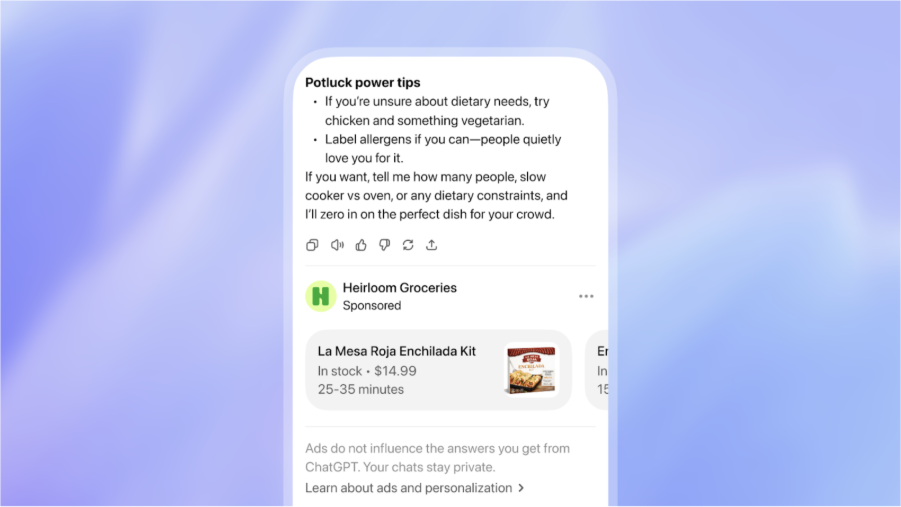
Ads appear at the bottom of a ChatGPT response, clearly labelled as sponsored and visually separated from the AI's answer. They do not appear inside the response itself, and advertisers have no ability to influence what ChatGPT says before the ad is shown.
Ads are only shown to users on the free and Go subscription tiers. This means the platform is inherently reaching a more cost-conscious, likely younger, and less professionally established audience than the full ChatGPT user base. For consumer brands, e-commerce, and businesses targeting a broad general audience, this may be perfectly viable. For B2B advertisers trying to reach senior decision-makers who are more likely to hold a paid subscription, you may not be able to reach the audience you want.
(source: https://help.openai.com/en/articles/20001047-ads-in-chatgpt)
Limitations
Several meaningful restrictions shape what advertisers can currently do on the platform, and UK buyers should go in with eyes open.
Reporting is extremely limited. Advertisers currently see impressions, clicks, spend, CTR, average CPC, and average CPM broken down by day. There is no audience insight, no placement data, no demographic breakdown, and no visibility into which conversation types triggered your ad or what ChatGPT said before it appeared. There is currently no way to understand why an ad performed the way it did, or how to improve it.
No brand safety controls. Advertisers cannot specify keyword exclusions, placement lists, or content category controls. OpenAI does exclude certain sensitive topics: health, mental health, and politics from ad placements, but beyond those defaults, advertisers are trusting OpenAI to show their ads in appropriate contexts. For brands with strict brand safety requirements, this lack of verification tools will be a barrier.
No conversion bidding yet. Conversion tracking is available, but the ability to bid toward conversion goals is said to be an upcoming functionality. Until that functionality is fully live and proven, the platform remains more suited to brand awareness and driving clicks over conversions.
No demographic or audience targeting. Unlike Google and Meta, there is no ability to target by age, gender, industry, job title, or any other audience attribute.
CTR appears fixed. Live testing has consistently shown a click-through rate of approximately 1% regardless of creative or targeting variations. If this holds, it suggests that at this stage the platform offers limited scope for creative optimisation. The system appears to be delivering a relatively uniform outcome regardless of what advertisers do.
No benchmark data. OpenAI itself acknowledges in its own documentation that the platform has no published performance benchmarks across advertisers, industries, or campaign types. There is no way to know whether your results are good, bad, or average relative to others in your sector.
Ads in the UK
OpenAI confirmed the UK rollout in May 2026, announcing that mid-conversation ad recommendations would arrive ‘in the coming weeks.’
Jellyfish, the global digital agency with operations on both sides of the Atlantic, has been among the early US testers and is now bringing that experience to UK clients. Their chief solutions officer for media activation, Jai Amin, has described the early results as broadly positive with some important caveats. (source: https://www.thecurrent.com/marketing/marketing-strategy-ai-british-media-buyers-preparing-chatgpt-ads)
The initial US pilot required a commitment of roughly $250,000 to $300,000 with premium CPMs around $60. In practice, CPMs came in closer to $30, and Jellyfish reports early conversions and high order values. However, Amin is clear that these early campaigns required clients to ‘take a bit of a leap of faith,’ treating the channel as brand awareness rather than a direct response vehicle to be judged against normal performance metrics.
For UK advertisers, Amin expects a similar rollout with at least three to four UK advertisers to participate in the initial wave, with a rough baseline commitment of around $100,000 over three months before the platform becomes self-serve.
What We Think
ChatGPT advertising is moving fast. The platform that launched in February 2026 as an invitation-only beta with six-figure spend commitments looks meaningfully different just a few months later. Many of the limitations outlined above are the limitations of a platform in its earliest stages, not necessarily the limitations of the platform it will become. We expect audience targeting, reporting depth, brand safety controls, and optimisation tooling to improve considerably over the course of 2026 and into 2027, and we will be keeping a close eye on developments as they happen.
That said, advertisers coming to this channel should do so with realistic expectations. Anyone treating this like a mature performance channel right now will likely be disappointed. What it does offer, for the right advertiser, is genuine first-mover opportunity. If you have a dedicated test budget and if your audience broadly fits the free-tier user base: consumer-facing brands, e-commerce, businesses targeting a broad or younger demographic, then there is a strong case for getting in early.
As for us, now the self-serve platform is available in the UK, we're running ads both for ourselves and for clients. While we're testing and learning, we're sharing what we find and how to best optimise this platform. If you're interested in running ChatGPT Ads for your own business, let's chat.
Interested in ChatGPT Ads? Talk to us today
